
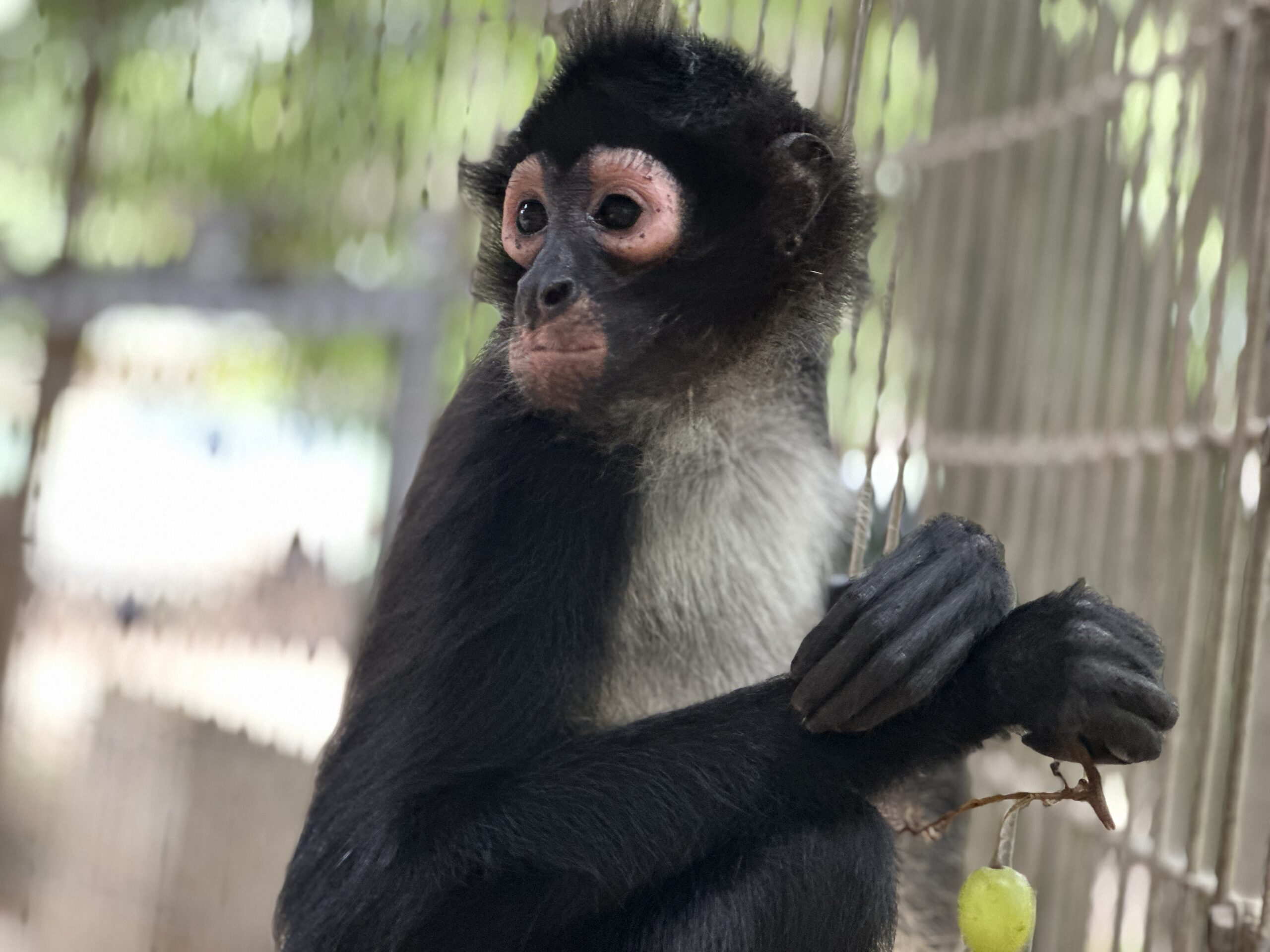
Say hello to our newest spider monkey Shep. Shep, who is about 2 years old, was exploited by the exotic pet trade before we rescued him in April. He had been in the possession of the U.S. Fish and Wildlife Service and then brought to the Houston Zoo.
While we’ve been rescuing primates from the illegal pet trade, biomedical research and entertainment for decades, last year we were chosen to be part of the Wildlife Confiscations Network. It’s a first-of-its-kind pilot program that strives to reduce wildlife trafficking and increases support for law enforcement by providing a coordinated system to ensure the care and welfare of confiscated live wildlife.
We learned from a U.S. Fish and Wildlife officer that about 90% of spider monkeys confiscated in Texas did not come from USDA-regulated primate breeding facilities; they were caught in the wild and smuggled over the border. That means Shep may have been living happily in the wild somewhere until a poacher came in and killed his entire troop to steal him.
We think Shep might be a good match for Sybil, the two-year-old female spider monkey who was found in someone’s front yard in Cibilo, Texas, last year. She was wearing a diaper and had an eye injury. A few hours later, the City of San Antonio Animal Care Services delivered her to PPI for permanent placement. Our veterinary team treated her eye so she could see out of both eyes again. Sybil has not shown any interest in bonding with our current population of 13 spider monkeys.
Thanks to social media, people seem to think monkeys make good pets! Nothing could be further from the truth. Spider monkeys do not belong in people’s living rooms. In the wild they live in the tropical rainforests, evergreen forests, and mangrove swamps of Central and South America, ranging from southern Mexico to Bolivia. They require vast territories and thrive in the high tree canopy. They are also highly social, living in groups of up to 40 members with intricate hierarchies and communication systems. Spider monkeys also have specialized diets that include fruits, nuts, seeds, insects, and leaves.